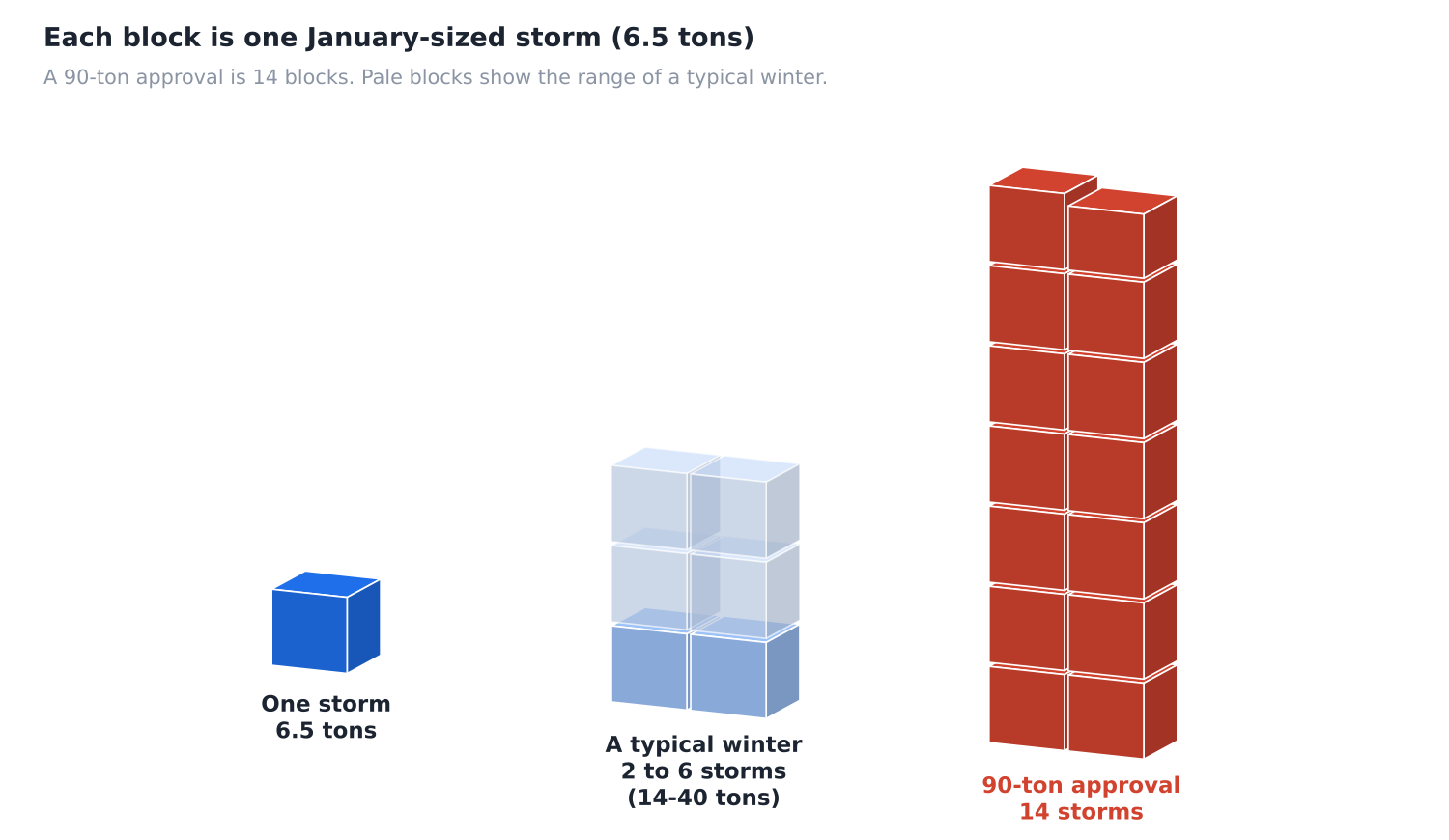
This report is my own educational estimate of how much road salt a snow event takes on our private roads. On the measurements and assumptions below, a single 6-8 inch storm comes out to roughly 4.5 to 6.5 tons over three applications, and a whole winter like 2025-26 (13.6 inches of snow in total at Dulles) comes out to roughly 9 to 15 tons. On those same assumptions, 90 tons is about 14 such storms, or about 6 to 10 typical winters, so it looks larger than a single event or a typical season would need.
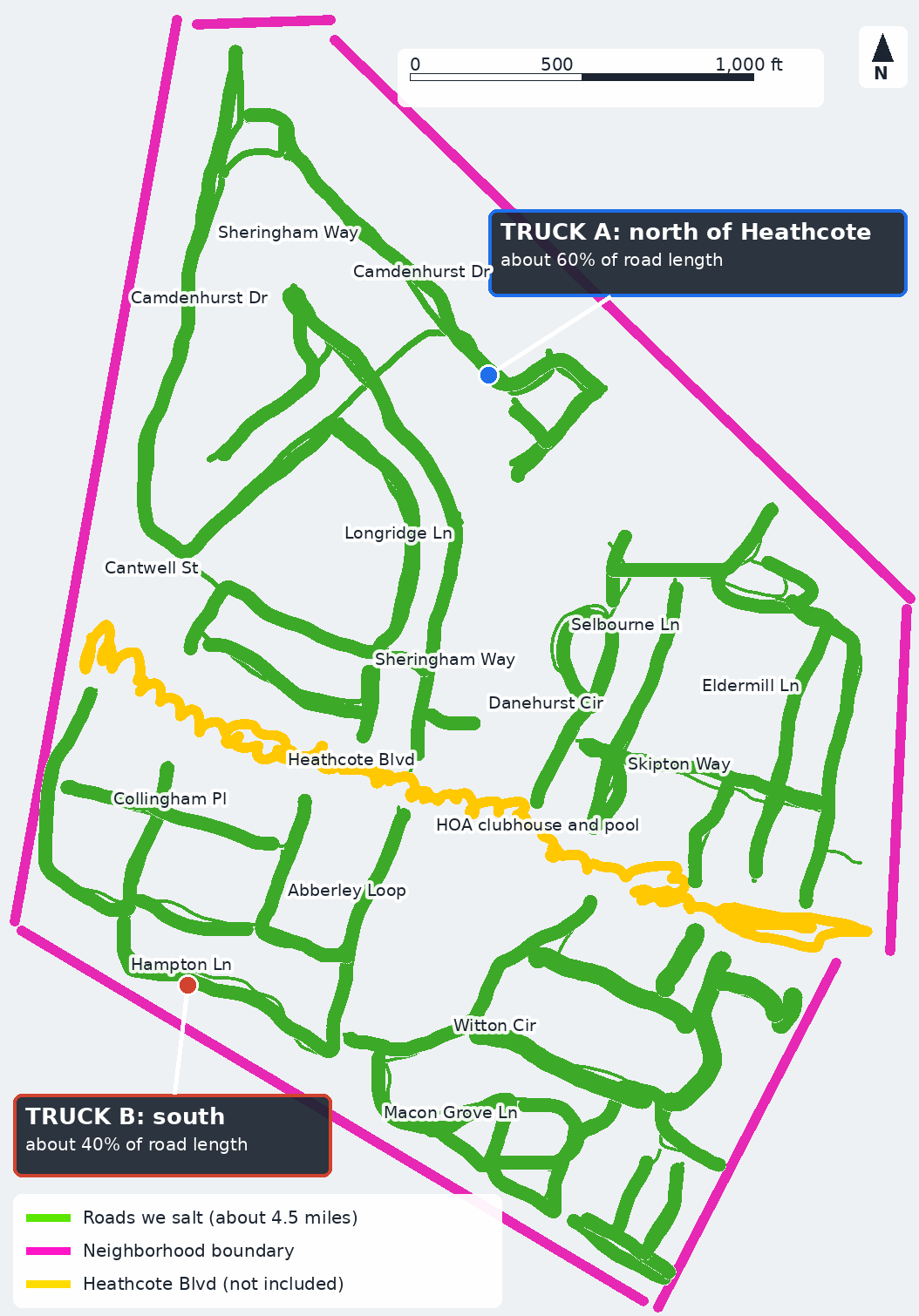
I traced our private roads on satellite imagery and scaled them to the map's 500 ft key. They add up to about 4.5 miles at 26 ft wide, which is roughly 624,000 sq ft of pavement. Heathcote Blvd, sidewalks and driveways are not included.
| Measure | Value | How I measured it |
|---|---|---|
| Road length (centerline) | about 24,000 ft (4.5 mi) | Roads traced on the satellite map and scaled to the 500 ft key; accurate to about ±15% |
| Pavement width | about 26 ft | Close-up satellite view with the 50 ft key |
| Area to treat | about 624,000 sq ft (14.3 acres) | Length × width |
| Lane-miles (12 ft lanes) | about 9.9 | Area ÷ 63,360 sq ft per lane-mile |
L is road length (ft), W is pavement width (ft), and R is the spread rate (lb per 1,000 sq ft). For our roads: 24,000 × 26 ÷ 1,000 = 624, and 624 × 6 lb = 3,744 lb, or 1.9 tons for one standard application.
| Condition | R (lb per 1,000 sq ft) | lb per lane-mile | Tons per application (our roads) |
|---|---|---|---|
| Pre-treat or light | 4 | 250 | 1.25 |
| Standard, after plowing (about 25-30°F) | 6 | 380 | 1.9 |
| Heavy: sleet, ice or about 20°F | 9 | 570 | 2.8 |
| Heavy, 10 inch storm | 10 | 630 | 3.1 |
Salt does not melt 6-8 inches of snow, so the roads get plowed first and the salt treats the layer that bonds to the pavement. I plan on three applications per storm: a pre-treat before or at the start, a pass after the first plowing, and a follow-up after refreeze.
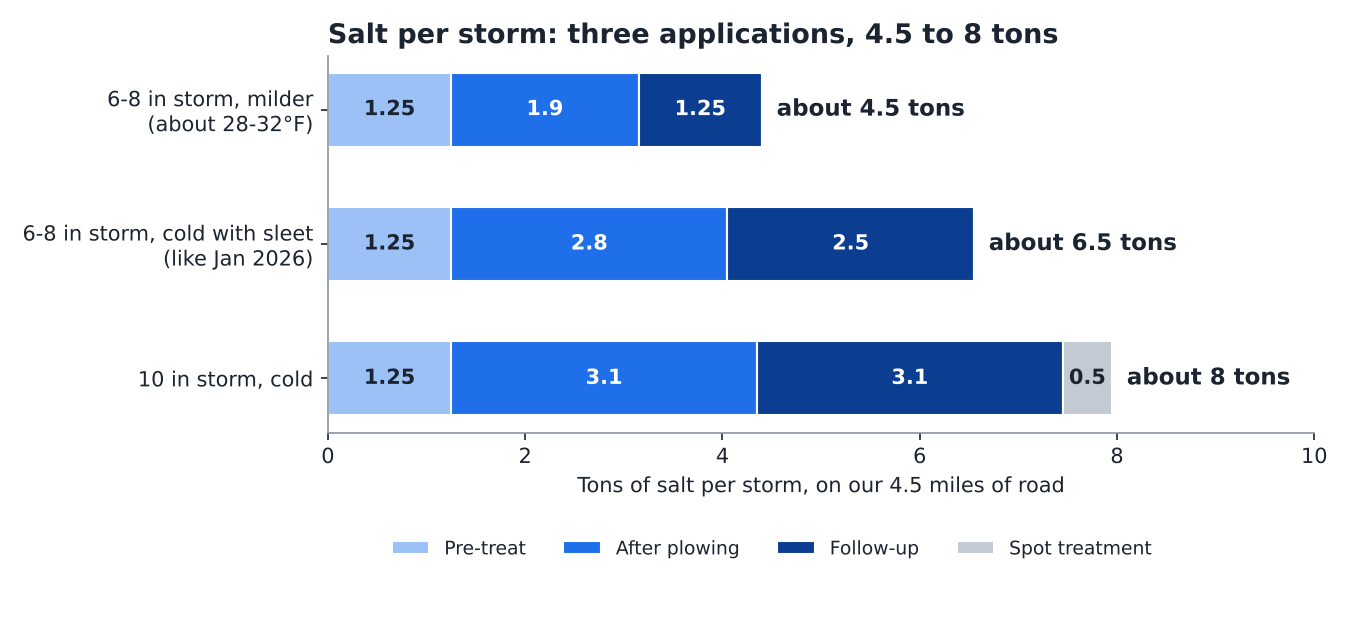
Two spreader trucks of 2-3 tons each can cover one application in about 45-60 minutes, with one reload each. Truck A takes the roads north of Heathcote Blvd, about 60% of the length, and Truck B takes the roads south of it. Plowing is the bigger job, so I would budget 2-3 plows as well.
I ran the formula against the January 24-25, 2026 storm to estimate what a salt plan for that storm could have called for. My estimate is about 6.5 tons in three passes, with a range of 5 to 9 tons. That storm was harder to treat than the same depth of dry snow because sleet and freezing rain bond to pavement, and the temperature stayed near 20°F. This is a planning estimate only; I am not saying what was or should have been done.
| Item | Conditions |
|---|---|
| Timing | Snow began Saturday evening, Jan 24; it turned to sleet Sunday morning, with freezing rain Sunday afternoon and evening; precipitation ended by about 8-10 p.m. Sunday |
| Accumulation | About 6-7 inches of snow and sleet in the Gainesville area, topped with a glaze of freezing rain (Prince William Times, Potomac Local) |
| Temperature | Around 20°F Sunday afternoon, lows in the teens Sunday night, and below freezing for about a week afterward (WTOP) |
| # | When | Purpose | Rate (lb per 1,000 sq ft) | Tons |
|---|---|---|---|---|
| 1 | Saturday evening, before the snow started | Anti-ice so the snow cannot bond to the pavement | 4 | 1.25 |
| 2 | Sunday, after the first plowing, as sleet set in | Treat packed snow and sleet at about 20°F | 9 | 2.8 |
| 3 | Sunday night or Monday morning, after the freezing rain ended | Break the glaze before it refroze in the teens | 8 | 2.5 |
| Total | about 6.5 |
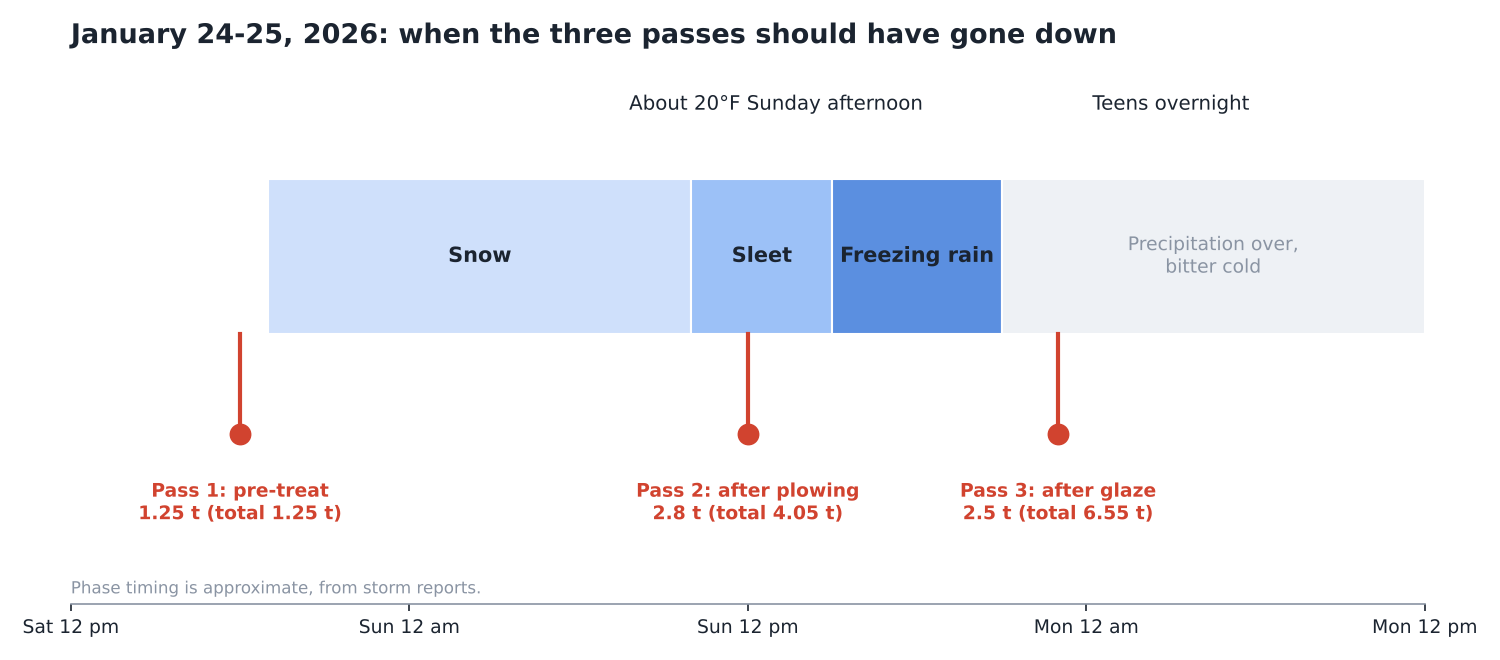
The low end of 5 tons assumes a brine pre-treat and a lighter follow-up. The high end of 9 tons adds a fourth pass or spot treatment of hills and intersections during the freeze that followed.
At 20°F and falling, plain rock salt is marginal. A pre-wetted salt, a calcium chloride blend, or a sand and salt mix on hills may be a better choice for passes 2 and 3, and a contractor can advise on products.
On my estimates, 90 tons is well above what a single storm would need: about 14 times a 6-8 inch storm and 11 times a 10 inch storm. As a full-season total, it equals roughly 110 inches of snow on the same assumptions, which is about 50% more than Dulles's snowiest winter on record. I do not know exactly what the approval is meant to cover, and it may reflect factors I have not modeled, such as stockpiling, contract terms or storage.
| Tons | lb per 1,000 sq ft | lb per lane-mile | Storms equal to 90 tons | |
|---|---|---|---|---|
| 90-ton approval | 90 | 288 | about 18,300 | n/a |
| 6-8 in storm (January 2026 basis) | 6.5 | 21 | about 1,300 | 14 |
| 10 in storm | 8 | 26 | about 1,600 | 11 |
A normal single pass puts down 200-600 lb per lane-mile, so 90 tons on one pass would be 30 to 90 times the normal rate.
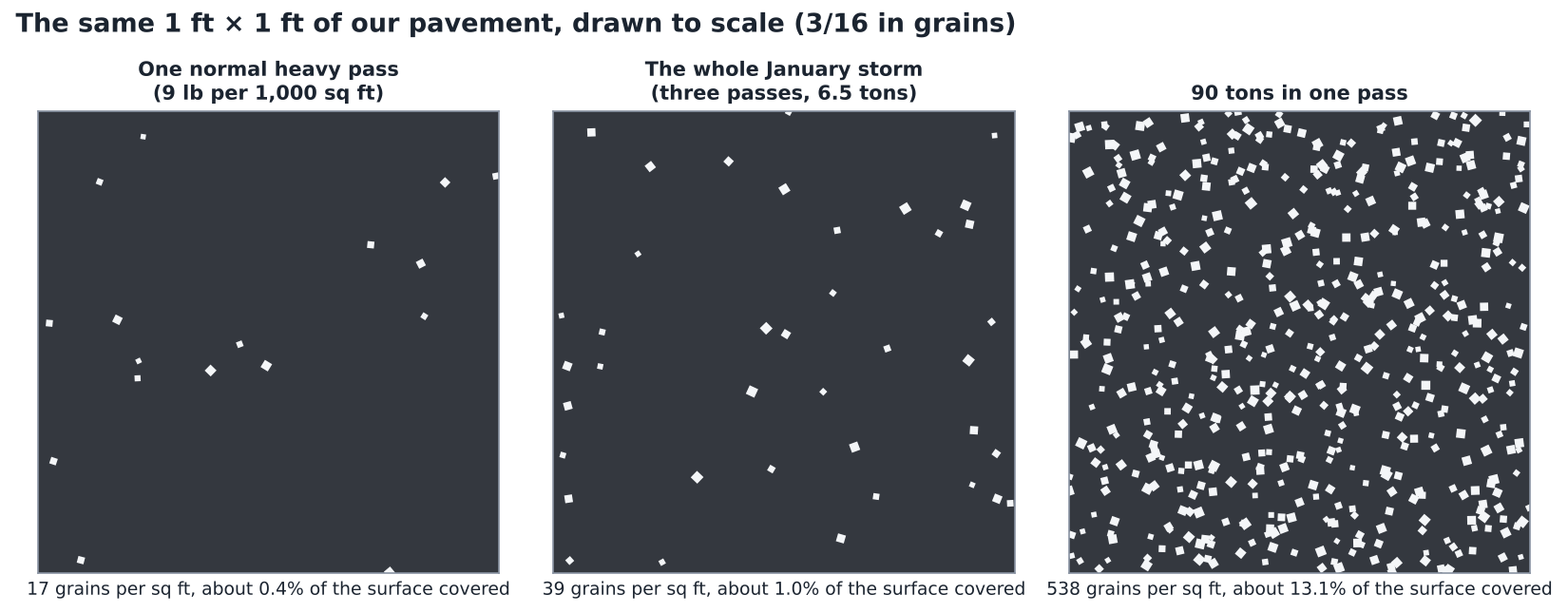
Spread evenly over our roads in one pass, 90 tons comes to about 0.29 lb per sq ft. One 50 lb bag would cover only about 174 sq ft (13 × 13 ft), where at a heavy normal rate one bag covers about 5,500 sq ft. The drawing below shows the same 1 ft × 1 ft of pavement three ways, with 3/16 inch grains drawn to scale: a heavy normal pass covers about 0.4% of the surface, the whole January storm about 1%, and 90 tons about 13%.
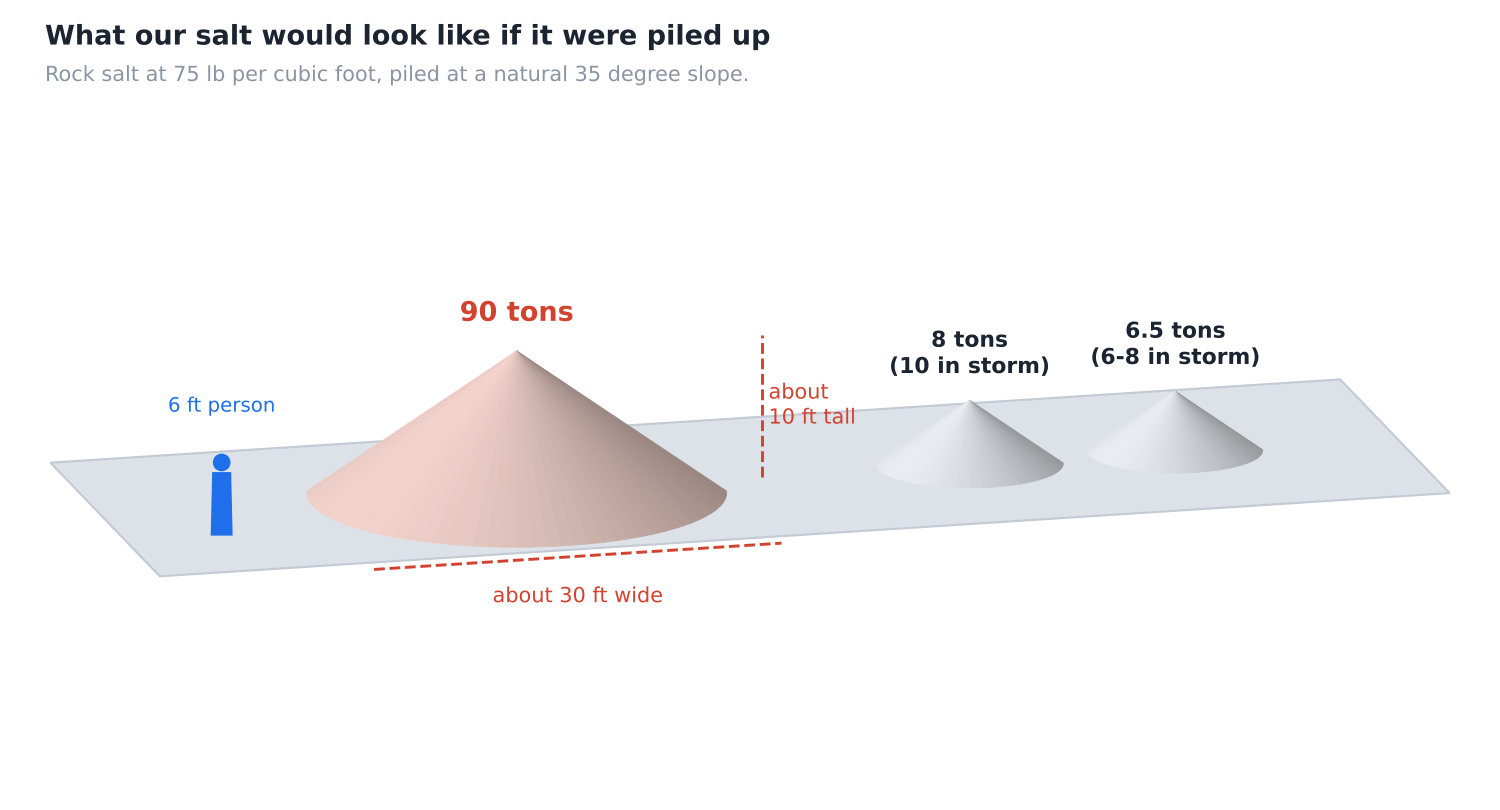
Piled in one place, 90 tons is about 3,600 bags of 50 lb, or roughly 89 cubic yards at 75 lb per cubic foot. That is a cone about 30 ft wide and 10 ft tall, next to 8 and 6.5 ton piles that are a fraction of the size.
Hauling 90 tons takes 9 tandem dump loads (10 tons each), 18 single-axle loads (5 tons) or about 50 pickup loads (1.8 tons). Spreading it is the real limit: no number of trucks can discharge 18,000 lb per lane-mile at road speed. Even at a heavy 2.8 tons per pass, 90 tons is 32 passes, or about 27 hours of continuous spreading with two trucks at about 50 minutes a pass.
The picture below stacks those loads one on top of another, so you can see the size of the job. It shows 50 pickup loads and 9 dump truck loads side by side, with a 2-story house, a 10-story building and a 30-story building marked for scale. The 9 dump trucks rise to about 95 ft, and the 50 pickups reach about 300 ft.
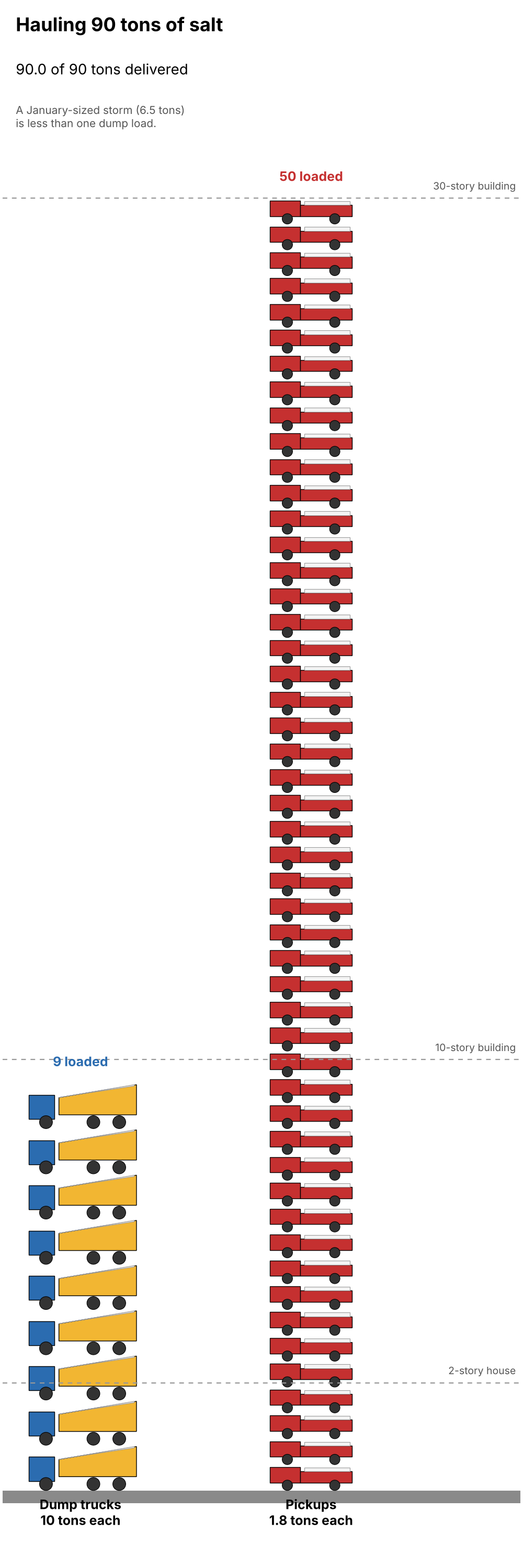
9 dump truck loads (10 tons each) stack to about 95 ft, taller than a 9-story building.
50 pickup loads (1.8 tons each) stack to about 300 ft, the height of a 30-story building.
A January-sized storm (6.5 tons) is less than one dump truck load.
Illustration at scale. Each load is one trip into our neighborhood.
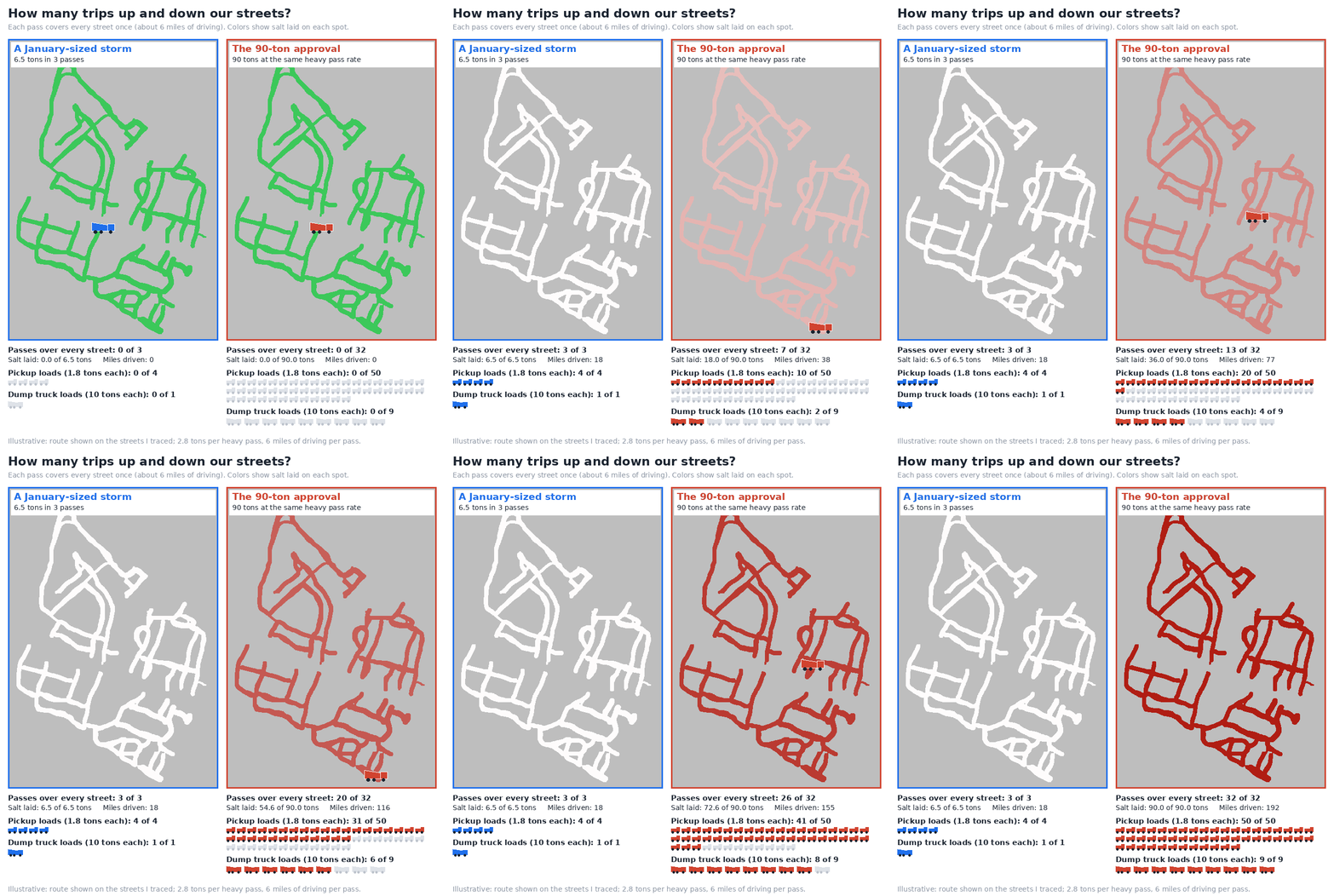
The animation below runs those trips over the streets I traced. Every sweep is one full pass over all of our roads, about 6 miles of driving. A January-sized storm is done after 3 passes, with 4 pickup loads or 1 dump truck load. Laying 90 tons at the same heavy pass rate takes 32 passes, about 190 miles of driving, 50 pickup loads or 9 dump truck loads. The colors show salt on each spot: white is one storm's worth, and red is many storms' worth piled onto the same road.
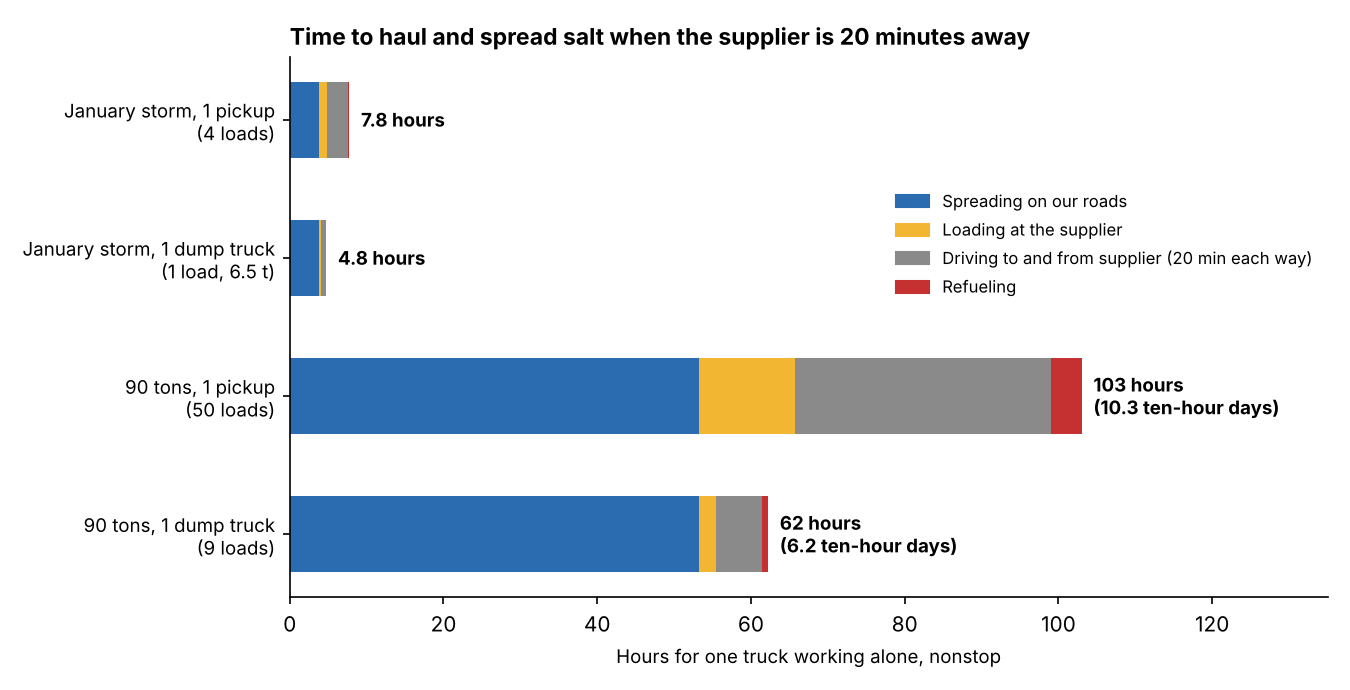
The trips above only count what happens on our streets. Salt does not sit in our neighborhood, so every load also means a trip to the supplier and back. I assumed the supplier is 20 minutes away, loading takes 15 minutes, refueling takes 15 minutes every third load, and a truck spreads about 1.7 tons per hour, which matches the 32 passes at about 50 minutes each with two trucks used earlier. A pickup carries 1.8 tons and a dump truck carries 10 tons.
| Scenario | Loads (trips to the supplier) | Hours, one truck | Hours, two trucks | Ten-hour workdays, one truck |
|---|---|---|---|---|
| January-sized storm (6.5 tons), pickup | 4 | about 8 | about 4 | less than 1 |
| January-sized storm (6.5 tons), dump truck | 1 | about 5 | n/a | less than 1 |
| 90 tons, pickup | 50 | about 103 | about 52 | about 10 |
| 90 tons, dump truck | 9 | about 62 | about 31 | about 6 |
On these assumptions, one pickup would make 50 round trips to the supplier and spend about 103 hours working, more than four days nonstop or about 10 ten-hour workdays. A dump truck would make 9 round trips and take about 62 hours. Spreading alone is about 53 hours in either case, so extra trucks cut the time but not the amount of salt on our roads. A faster spreader or a closer supplier would shorten these times, and a farther one would lengthen them.
About 11 (90 ÷ 8 tons), with a range of 9 to 14 if a storm needs 6.5 to 10 tons. That is about 110 inches of snow in one winter. Dulles averages about 22 inches a season (WTOP), and its record is 73.2 inches in 2009-10 (NWS Sterling).
Snow totals vary a lot from one winter to the next, so the salt we need does too. These are seasonal totals (July to June) at Washington Dulles Airport, the nearest official station with a long record. They are not measurements from our neighborhood, and they do not capture ice storms.
| Winter | Dulles snowfall (inches) | Note |
|---|---|---|
| 2016-17 | 7.3 | |
| 2017-18 | 11.9 | |
| 2018-19 | 26.5 | |
| 2019-20 | 2.9 | |
| 2020-21 | 12.0 | |
| 2021-22 | 15.8 | |
| 2022-23 | 0.4 | Lowest on record |
| 2023-24 | 11.7 | |
| 2024-25 | 15.5 | NWS figure is preliminary |
| 2025-26 | 13.6 | Total as of March 13, 2026; includes the January 24-25 storm (7.8 inches at Dulles) |
These 10 winters average about 11.8 inches a season, against a long-term normal of about 21 inches. The range runs from 0.4 inches (2022-23) to 26.5 inches (2018-19). Every winter had some snow, but in several of them there may have been few or no events big enough to need heavy salting. This is a reason to look at how many tons were actually used each winter, not only the budget.
The 13.6 inches is the season total at Dulles. It includes the January 24-26 storm (7.8 inches at Dulles) and other, smaller events, so the 6.5-ton estimate above covers only that one storm. About 5.8 inches fell in other events that I could not itemize. I assumed two or three small events of 1 to 3 inches each, treated with one light pass of about 1.25 to 2 tons.
| Event | Snow | Salt estimate |
|---|---|---|
| January 24-26 storm | about 7.8 inches at Dulles; 6-8 inches near us | about 6.5 tons (range 5-9) |
| Other events (2-3 assumed) | about 5.8 inches combined | about 2.5-6 tons |
| Full winter | 13.6 inches | about 9-15 tons, most likely 9-12 |
At $250 per ton, that is about $2,250 to $3,750 of salt for the winter. The split into smaller events is my assumption; the contractor's logs would show the real number of treatments and the tons used for each.
In my opinion, 90 tons looks high for what our roads need. On my estimates, a typical winter like 2025-26 needs about 9-15 tons, and a heavy winter with 3-5 large storms needs about 14-40 tons. That makes 90 tons about 6 to 10 times a typical winter and 2 to 6 times a heavy one. These are rough planning figures for discussion, not limits. Treatment decisions for safety belong to a qualified contractor and the board, who can see conditions and records that I cannot. Heavy salt use can also affect stormwater ponds, concrete, landscaping and vehicles.
I do not know how the current salt budget was built, so I would like to ask:
The prices below are quotes I received from these suppliers on November 17, 2026. Prices, fees and availability change, so please call them to confirm before relying on any figure. Listing a company is not an endorsement or a recommendation.
| Fairfax Stone & Paver Depot | |
|---|---|
| Address | 44200 Wade Dr, Chantilly, VA 20152 |
| Phone | 703-270-3555 |
| Website | fairfaxstone.com |
| Bulk salt availability | Loose road salt sold by the scoop |
| Price per ton | $250 |
| Delivery fee | $125 |
| Elkwood Stone & Mulch | |
|---|---|
| Address | 13715 Berry Hill Rd, Elkwood, VA 22718 |
| Phone | 540-829-9273 |
| Website | elkwoodstone.com |
| Bulk salt availability | Loose road salt sold by the ton; delivery offered |
| Price per ton | $235 |
| Delivery fee | $225 |
At the quoted $235 to $250 per ton, salt costs about $1,100 to $1,600 for one 6-8 inch storm and about $21,000 to $22,500 for 90 tons. Each delivery adds the fee above, and the number of deliveries depends on the load size. These figures leave out spreaders, labor, plowing and storage.
| Scenario | Tons | Salt at $235 per ton | Salt at $250 per ton |
|---|---|---|---|
| One 6-8 inch storm | 4.5-6.5 | $1,058-$1,528 | $1,125-$1,625 |
| One 10 inch storm | about 8 | about $1,880 | about $2,000 |
| A typical winter (like 2025-26) | 9-15 | $2,115-$3,525 | $2,250-$3,750 |
| A heavy winter (3-5 large storms) | 14-40 | $3,290-$9,400 | $3,500-$10,000 |
| 90-ton approval | 90 | $21,150 | $22,500 |
Sources: WTOP, Jan 25 2026 storm · Potomac Local · Prince William Times · NWS Sterling snowfall records · WTOP, Dulles averages · NWS Sterling, Dulles seasonal snowfall · Washington Post, March 2026 · WTOP, Jan 2026 snow totals